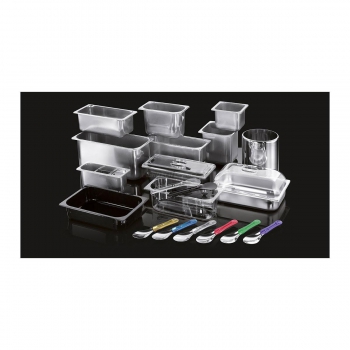
Agritechstore offers a complete line of AISI 304 stainless steel basins and ice cream makers, as well as top-quality accessories for ice cream parlors that meet the strictest regulations in force.
AISI 304 belongs to the austenitic steel family and is the most widely used.
This type of steel is used because it ensures very high performance in terms of deformation and guarantees excellent resistance to corrosion.
The sharp increases in the price of nickel over the last 10 years have contributed to the spread of steels in which there is a partial or almost total substitution of nickel with manganese (200 Series).
These new types of steel introduced on the market have the advantage of a significantly lower cost compared to the 300 series but also a series of problems that cannot be overlooked by those who use them.
A chromium content of 18% is not compatible with low nickel values, without the formation of ferrite. For this reason, the chromium content in 200 series steels is lower, at 15-16% and in some cases 13-14%, making their corrosion resistance not comparable to that of type 304 and/or similar steels. The lower the chromium content, the greater the risk of intergranular corrosion due to the precipitation of carbides at the grain boundaries.
Although manganese is an austenizing agent, it is not as effective as nickel, which is second only to nitrogen. Its repassivation properties are reduced in acidic conditions, and therefore the dissolution rate of 200 series steels is approximately 10 to 100 times higher than that of 304. Nickel, in addition to imparting toughness to the steel, promotes self-passivation.
Often these materials (Series 200) are produced in plants that do not allow for the control of residual sulphur levels and the percentage of carbon and, even more seriously, there is no traceability of the material used, often deliberately hidden.
This last aspect has direct repercussions on others, such as material recycling: if undeclared, chromium-manganese stainless steel can become a source of dangerous scrap mixes, which consequently generate castings unexpectedly rich in manganese.
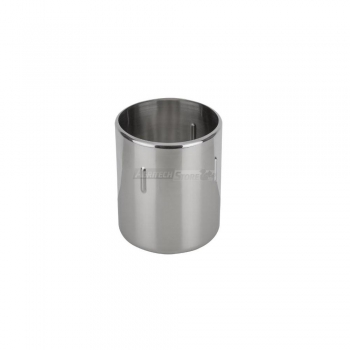
To be able to use this anti-rotational carapina it is important that it is compatible with the insertion well.